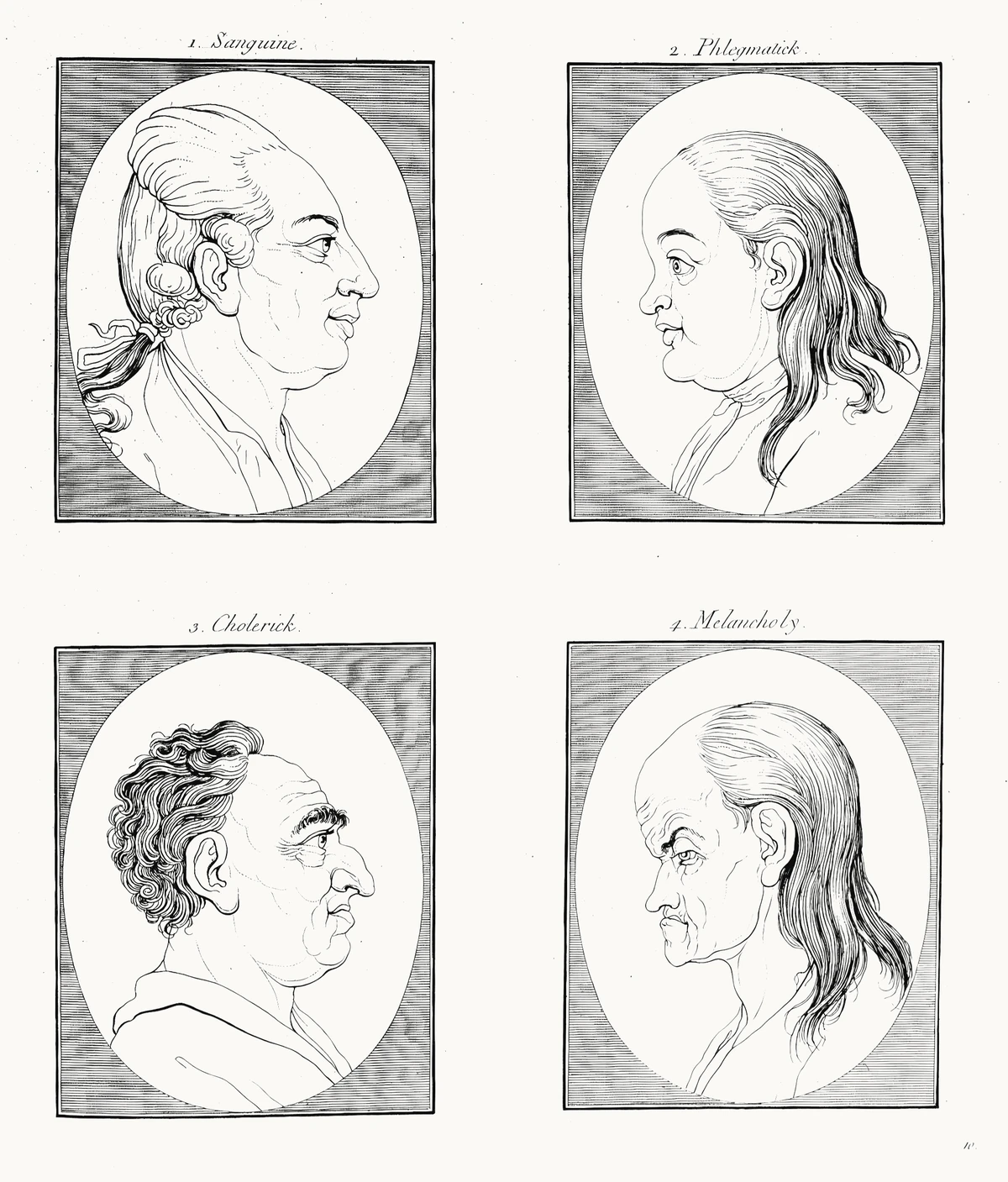
THE FOUR HUMORS, of Greece, later of Rome and then of essentially everywhere, died in the nineteenth century after a long illness. The theory was approximately 2,300 years old.
Born in the Hippocratic corpus and raised to its full height by Galen in the second century, the deceased held that the body contained four fluids, that health was their balance, and that illness was one of them getting above itself. Blood, phlegm, yellow bile, black bile. Hot, cold, wet, dry. A complete and internally consistent account of every human ailment, requiring no instruments and permitting no test.
It was wrong in every particular and it worked for two thousand years, in the sense that it was never once contradicted by anything its adherents were willing to measure.
The cause of death was not a single discovery. It was arithmetic, cell theory, germ theory and the microscope arriving over several decades and steadily leaving the deceased with nothing to explain. There was no deathbed. It simply stopped being cited, which is how theories actually die and why nobody sends flowers.
Survived by
Four personality types, all four still in daily use. Anybody described as sanguine is being described by their blood. Melancholy is black bile, literally, melas kholē. Phlegmatic is exactly what it looks like. Choleric is yellow bile getting the better of somebody in traffic. Four words that ninety-nine people in a hundred use without knowing they are reporting a fluid level.
One idiom. To be in a bad humor is to have a fluid out of balance, and you have said it this month.
A commercial empire. Every product sold on the premise that something has accumulated in you and requires flushing is the deceased's direct heir. The words have modernized. Toxins, cleanse, reset, balance. The proposition has not moved a millimeter in 2,300 years: there is too much of something in you, and for a fee this can be drawn out.
The deceased is also survived by the conviction that a theory which explains everything is a strong theory, rather than the most obvious possible warning sign.
In lieu of flowers
Check what you currently believe about your own body, and ask which part of it anybody has counted.
Services were not held. Attendance had been falling for years.
Sources
- The Hippocratic corpus for the origin of humoral theory, and Galen (c. 129 to 216 AD) for the systematization that carried it forward.
- Standard etymologies for sanguine, melancholy (Greek melas kholē, black bile), phlegmatic and choleric, all four derived directly from the humors.
- The displacement of humoral medicine by cell theory, germ theory and clinical statistics across the nineteenth century, rather than by any single experiment.