On 24 December 1696 an Edinburgh jury found a twenty-year-old student guilty of blasphemy. On 8 January they hanged him on the road to Leith.
He had already taken it all back. In writing. Point by point, in a petition to the court, before the trial: the Trinity, the immortality of the soul, the resurrection of the body, the divine authority of both Testaments. He wrote that he abhorred the charges so much he could not stand to repeat them himself.
None of it mattered, and the reason it did not matter is the most useful thing in this entire case. Scotland had two blasphemy statutes on the books that winter. They did not carry the same penalty. Which one applied to you came down to which verb somebody else wrote on the form.
Two Acts, Two Prices
The older one is the Act against the crime of blasphemy, passed at Edinburgh on 16 May 1661. It is short and it is not complicated. Anyone who, "not being distracted in his wits," shall "rail upon or curse God" or any person of the Trinity is to be tried, and if found guilty, "shall be punished with death." Denying God counted too, but only where the accused obstinately persisted in it. The persisting was the crime, not the denial.
The newer one passed on 9 May 1695, thirty-four years later, and it covered a different activity. Where the 1661 act is about cursing, the 1695 act is about thinking out loud: to "deny, impugn or quarrell, argue or reason" against the being of God, the persons of the Trinity, the authority of the Scriptures, or providence.
And for that, it built a staircase.
First offence: prison until you make public satisfaction in sackcloth in front of the congregation where you did it. Second offence: a year's valued rent of your real estate and a twentieth of everything else, half to the poor of the parish and half to whoever turned you in. Third offence: death, "as an obstinat blasphemer."
Three strikes. Put that beside the first act. In 1695, the Parliament of Scotland decided that arguing against the existence of God was worth a public apology in sackcloth the first time you did it. The same Parliament left cursing God on the books as a hanging offence the first time you did it, because the 1695 act ratified the 1661 one on its way past.
So by the winter of 1696 the law said this. Reason your way out of God and you owe the congregation an afternoon in a sack. Say something rude about him and you die.
The Indictment Pleaded Both
The indictment is where this stops being a story about religion.
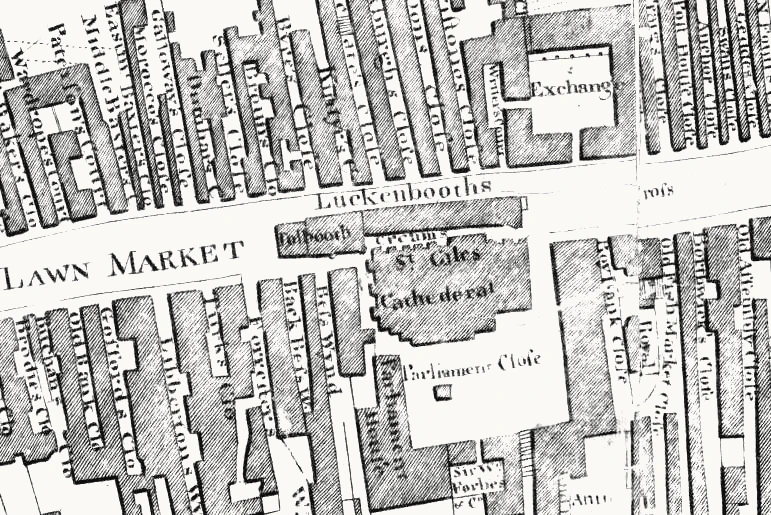
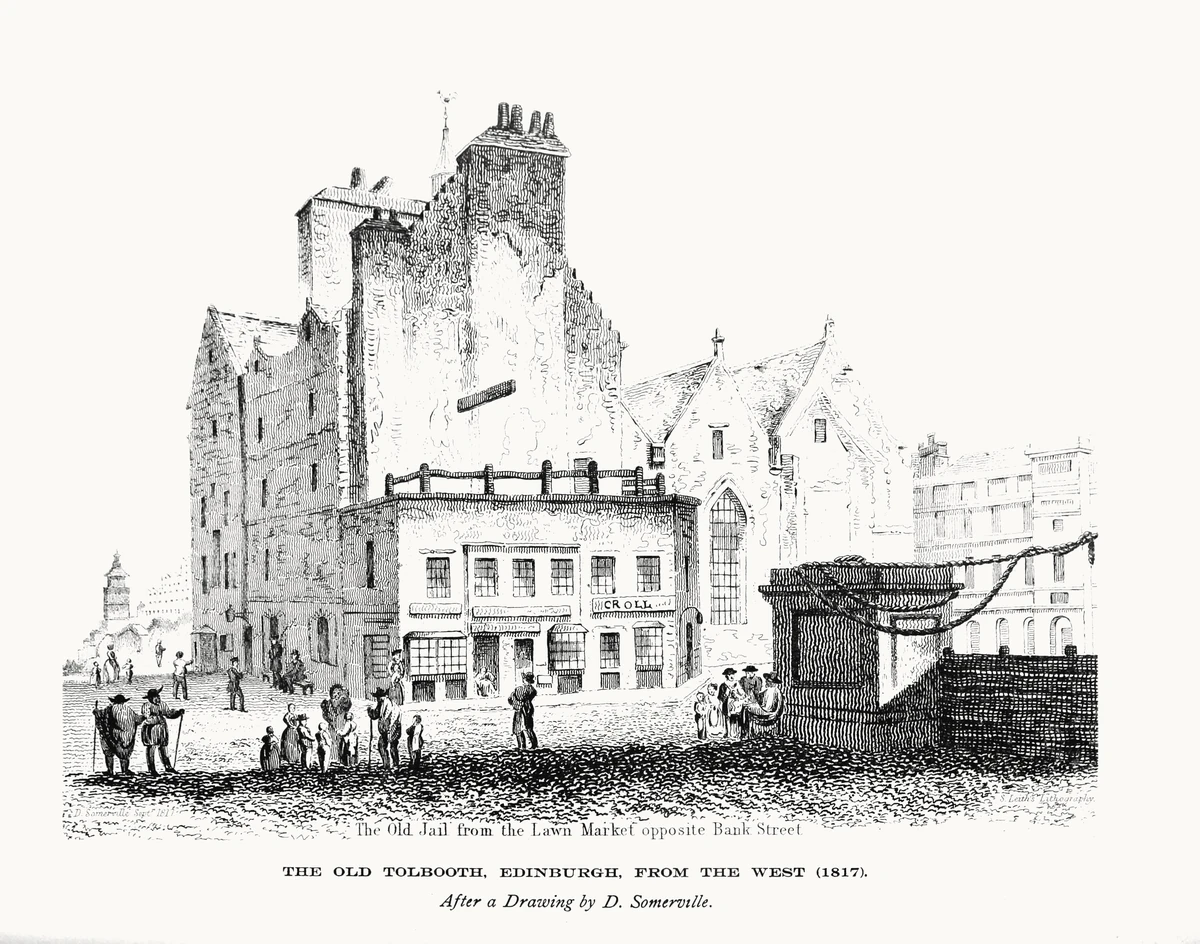
It opens the way these documents open, with an address. Thomas Aikenhead, "sone to the deceast James Aikenhead, chirurgeon, in Edinburgh, prisoner in the Tolbuith thereof." The Tolbooth stood in the middle of the High Street, jammed against the west end of St Giles, with shops built into its ground floor. It is where he wrote everything he wrote.
The charges themselves did not pick one. It quotes the 1661 act, then quotes the 1695 act, and charges him with "railling against and cursing our Lord and Saviour Jesus Christ," and with "impugneing and denying the truth of the holy Scriptures," and with "the quarrelling and argueing against the being of God and against his providence in making and governing the world."
Those are not three ways of saying the same thing. The first clause is the capital act. The second and third are the sackcloth act. The Lord Advocate wrote the survivable charges and the fatal one into a single sentence and handed it to the court.
The court then did the only thing it could do with a document like that, which is sort it. The ruling survives:
they ffind the cursing or railing upon any of the persones of the blessed [Trinity] relevant to inferr the paine of death; and ffinds the other crymes lybelled relevant to inferr an arbitrary punishment
"Arbitrary punishment" is not an insult. It is a term of art. It means a penalty at the court's discretion rather than one fixed by statute. Prison. Sackcloth. Whatever they felt was appropriate.
So the bench said it in writing, before the jury heard a word: everything this boy is accused of is survivable except one, and the one is railing.
Nobody Proved The Only Charge That Mattered
Everything now turned on whether he had railed rather than argued. He had, by this point, retracted the arguing.
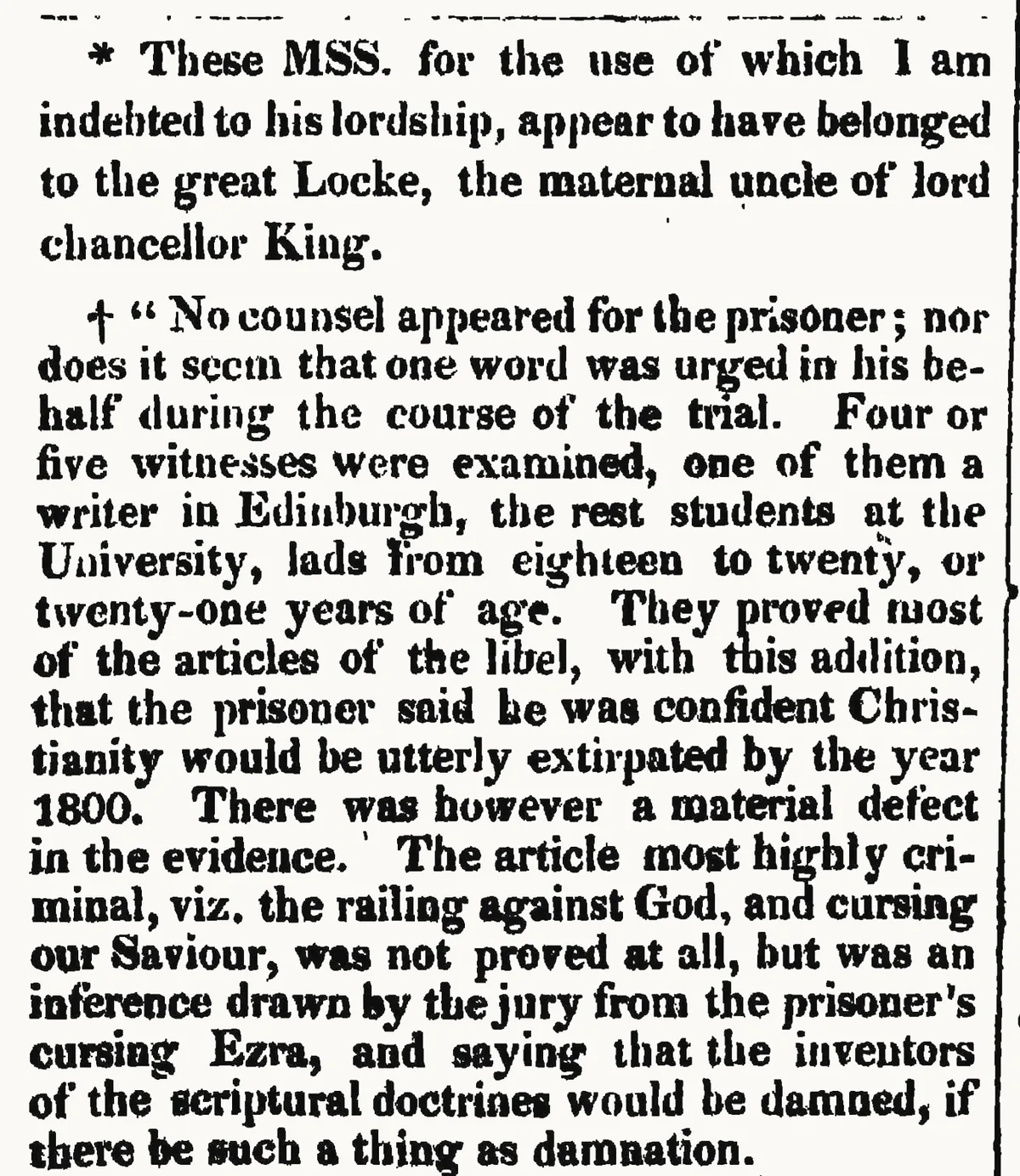
Howell's editors print a long footnote at this point, quoted from Hugo Arnot, an Edinburgh advocate who went through the Scottish criminal records and published his own account in 1785. He is a lawyer reading the file eighty-eight years after the fact, not a witness, and that is worth holding onto. What he says is this:
The article most highly criminal, viz. the railing against God, and cursing our Saviour, was not proved at all, but was an inference drawn by the jury from the prisoner's cursing Ezra, and saying that the inventors of the scriptural doctrines would be damned, if there be such a thing as damnation.
Not proved at all. Inferred.
Arnot goes on: the jury returned a verdict finding him guilty of railing against God and cursing Christ and of every other article, and "this verdict the jury, even by the statute, were not warranted to pronounce."
That is one lawyer's reading, published in 1785. He is arguing a case, and the case he is arguing is that the word that killed Aikenhead was not something a witness swore he heard but something the jury worked out.
A contemporary, writing in February 1697 with the evidence and the petitions in front of him, read it a shade differently and got somewhere just as bad. It is plain, he wrote, that Aikenhead must have died by the first act, since it was his first fault, and he had retracted, which cleared him of the denial article. And then: "Now the words of the first article being 'railing' and 'cursing,' no evidence except that of Mr. Mungo Craig's seems to answer the meaning of those words."
One witness, on that reading. Mungo Craig, who said Aikenhead had called Christ an impostor. Aikenhead denied Craig's evidence in his dying speech, and the letter writer went further, calling Craig "the decoy who gave him the books and made him speak as he did."
Two accounts of where the capital word came from, eighty-eight years apart. The man writing in 1697 says a single witness supplied it. The lawyer writing in 1785 says nobody supplied it and the jury filled in the blank. Neither of them says it was proved.
The witnesses could not keep the rest straight either. The line everybody still quotes about Aikenhead, that Moses was the better artist and the better politician than Jesus, is a line the witnesses did not agree on. One of them said he had named Muhammad.
Nobody Appeared For Him
Arnot again, six words: "No counsel appeared for the prisoner." He adds that it does not seem one word was urged on his behalf during the whole trial. The witnesses against him were a writer in Edinburgh and a group of university students, lads of eighteen to twenty-one.
He petitioned anyway.
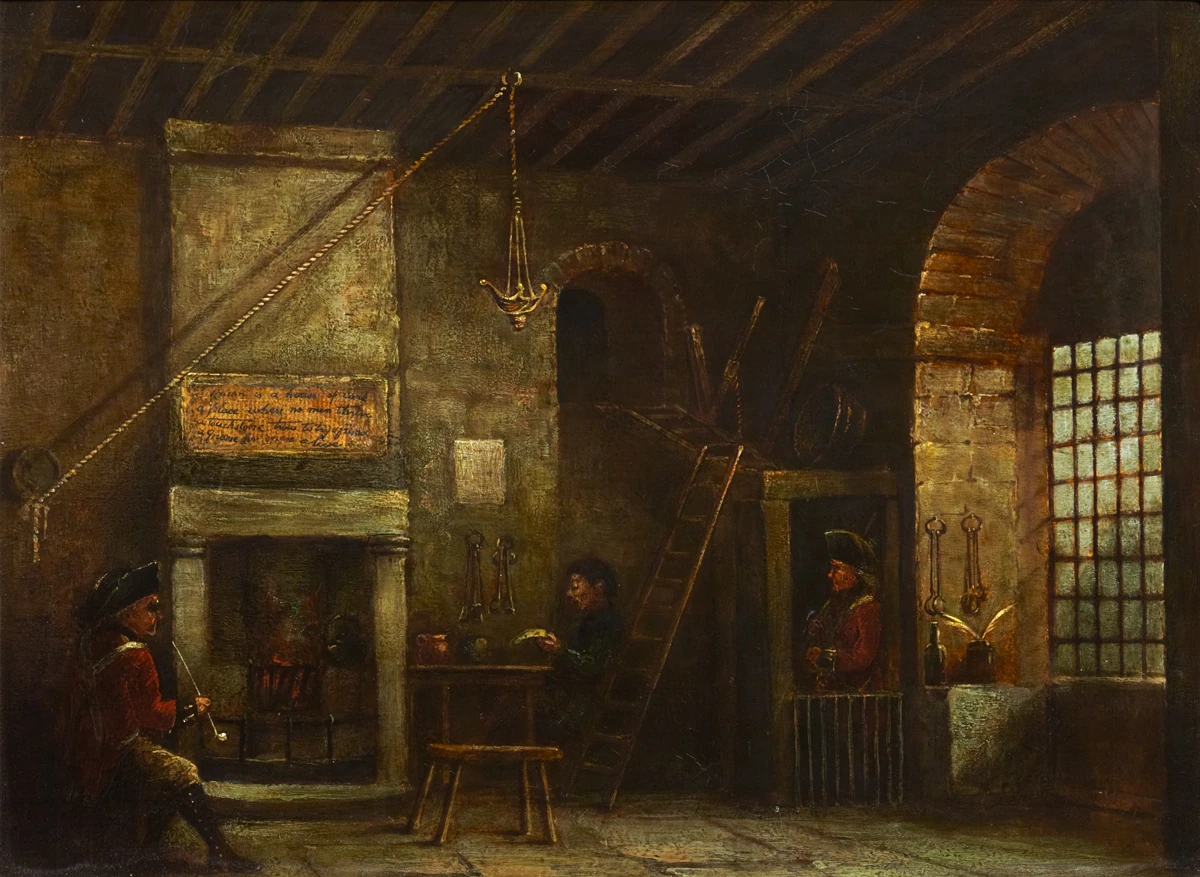
Then he petitioned the Privy Council. Two ministers and two Privy Councillors argued for him and got nowhere. On 7 January, the day before the execution, the Council produced one of the great pieces of administrative choreography in British legal history. It ruled that it would not grant a reprieve unless the church interceded for him.
The church was then asked. The General Assembly urged "vigorous execution" to curb "the abounding of impiety and profanity in this land."
That is a council handing a boy's life to a committee, and the committee sending him back with a note.
He was hanged the next day on the road between Edinburgh and Leith.
Every man in that building could read. The statute was four pages long and sitting on the table, and the price of each verb was printed in it.
The Press Got It Wrong Immediately
One more thing, because it is the smallest detail in the file and it has aged the best.
The February letter mentions that the Flying Post, a London newspaper, had reported that Aikenhead did not retract until the day of execution. The writer had the actual petitions in his hands. "Which you see," he wrote, "is false."
He retracted before the trial. The paper ran it the other way, because the other way is a better story, and the better story is that he was defiant to the end instead of a frightened kid who signed everything they put in front of him and got hanged anyway.
And We Still Do This
The machinery here is not the gallows. It is the charge sheet.
Somebody looked at a pile of things a boy said in a tavern and decided which column each one went in, and the column decided everything that happened afterward. Nothing about the facts changed between sackcloth and the rope. The facts were the same facts. The only thing that changed was which word got written on the form, and the person writing the form was the person who wanted the result.
We do this constantly, and we have gotten much better at it. Letting someone go is a restructuring. A denial is a coverage determination. A sacking is a mutual decision. Behavior gets sorted into the bucket that produces the desired consequence, and then everyone points at the bucket. The bucket did it. The bucket is just policy.
We are fine with it right up until it is our turn to be sorted, and then we find out what Aikenhead found out on the Leith road, which is that you do not get to pick your own verb.
What We Actually Know
Nearly everything above comes from the trial record as printed in Howell's State Trials, which reproduces the indictment, the court's ruling, Aikenhead's petitions, and the February letter.
Two things in there are commentary rather than record, and they are the two doing the most work, so they get named.
The passage about the capital article being inferred rather than proved is Hugo Arnot's, printed as a footnote by Howell's editors and credited to page 326 of his 1785 collection. It is a lawyer's argument about a trial he did not see, made eighty-eight years later, and it should be read as one. It is not testimony and it is not part of the record.
The February 1697 letter is contemporary, but its authorship is not certain. Howell's editors say the manuscripts "appear to have belonged to the great Locke, the maternal uncle of lord chancellor King," and attribute the letter to Locke writing to Sir Francis Masham. "Appear to have" is their hedge, and we are passing it along attached rather than flattening it into a byline.
The number of witnesses is not settled. Arnot himself says four or five, which is a strange thing to be vague about and an honest thing to print. We are not going to pick one to make the paragraph tidier.
He was twenty. He took it all back in writing. They hanged him anyway, and the reason they could is that the man who wrote the indictment knew which word cost more.
Sources
- Act against the crime of blasphemy, 16 May 1661, Records of the Parliaments of Scotland, for the quoted capital wording "rail upon or curse God," for the fact that denial was capital only where the accused obstinately persisted, and for the absence of any first-offence tier. <https://www.rps.ac.uk/search.php?action=print&id=36756&filename=charlesii_trans&type=trans>
- Act against blasphemy, 9 May 1695, Records of the Parliaments of Scotland, for the quoted conduct it covers, for the three graduated penalties including sackcloth on a first offence and death "as an obstinat blasphemer" on a third, and for the fact that it ratifies the 1661 act. <https://www.rps.ac.uk/search.php?action=print&id=57945&filename=williamii_ms&type=ms>
- "Proceedings against Thomas Aikenhead, for Blasphemy," in T. B. Howell, A Complete Collection of State Trials, vol. 13. Documentary: the indictment, which quotes both acts; the ruling of the justiciary separating the capital charge from the rest; Aikenhead's signed petition and retraction filed before trial; and the letter of 27 February 1696/7 including the Mungo Craig passage, the "decoy" line and the correction of the Flying Post. The case opens at column 917. <https://archive.org/details/in.ernet.dli.2015.91520>
- Hugo Arnot, A Collection and Abridgement of Celebrated Criminal Trials in Scotland, from A.D. 1536, to 1784 (1785), p. 326, as quoted in a footnote by Howell's editors, for the statements that no counsel appeared, that four or five witnesses were examined, that the railing article "was not proved at all, but was an inference drawn by the jury," and that the jury's verdict was one it "were not warranted to pronounce." Arnot is a later commentator, not a witness, and the post says so. <https://archive.org/details/acollectionanda01arnogoog>
- Images. The hero is a crop of leaf 471 of the State Trials scan at source 3. The Tolbooth exterior is after a drawing by D. Somerville, 1817, printed in the Book of the Old Edinburgh Club, vol. 4, 1911 (<https://archive.org/details/bookofoldedinbur4191olde>). The interior is William Clark's Hall of the Old Tolbooth, about 1795, City of Edinburgh Council. The plan detail is from Alexander Kincaid, 1784. All four are public domain and all four are scans of real objects. Nothing here was generated.
- Thomas Aikenhead, Wikipedia, for the dates of indictment, verdict and execution, the Privy Council's refusal to reprieve without the church's intercession, the General Assembly's quoted urging of "vigorous execution," and the witness disagreement over Moses and Muhammad. <https://en.wikipedia.org/wiki/Thomas_Aikenhead>
- Not asserted: that Aikenhead was the last person executed for blasphemy in Britain. It is widely repeated and it may well be true. It was not verified for this post, so the post does not claim it.
- Not asserted: the time of day of the execution, the Bible reported in his hand at the gallows, or Macaulay's account of the ministers at the scaffold. The first is single-sourced, the second is hedged in its own source, and the third is an opinion written well over a century later.
- Not resolved: how many witnesses testified, or whether the capital word came from one witness or from the jury's inference. Two contemporaries disagree. The post carries both rather than choosing.