Do cats know their own names?
Yes, with a caveat that turns out to be the whole story.
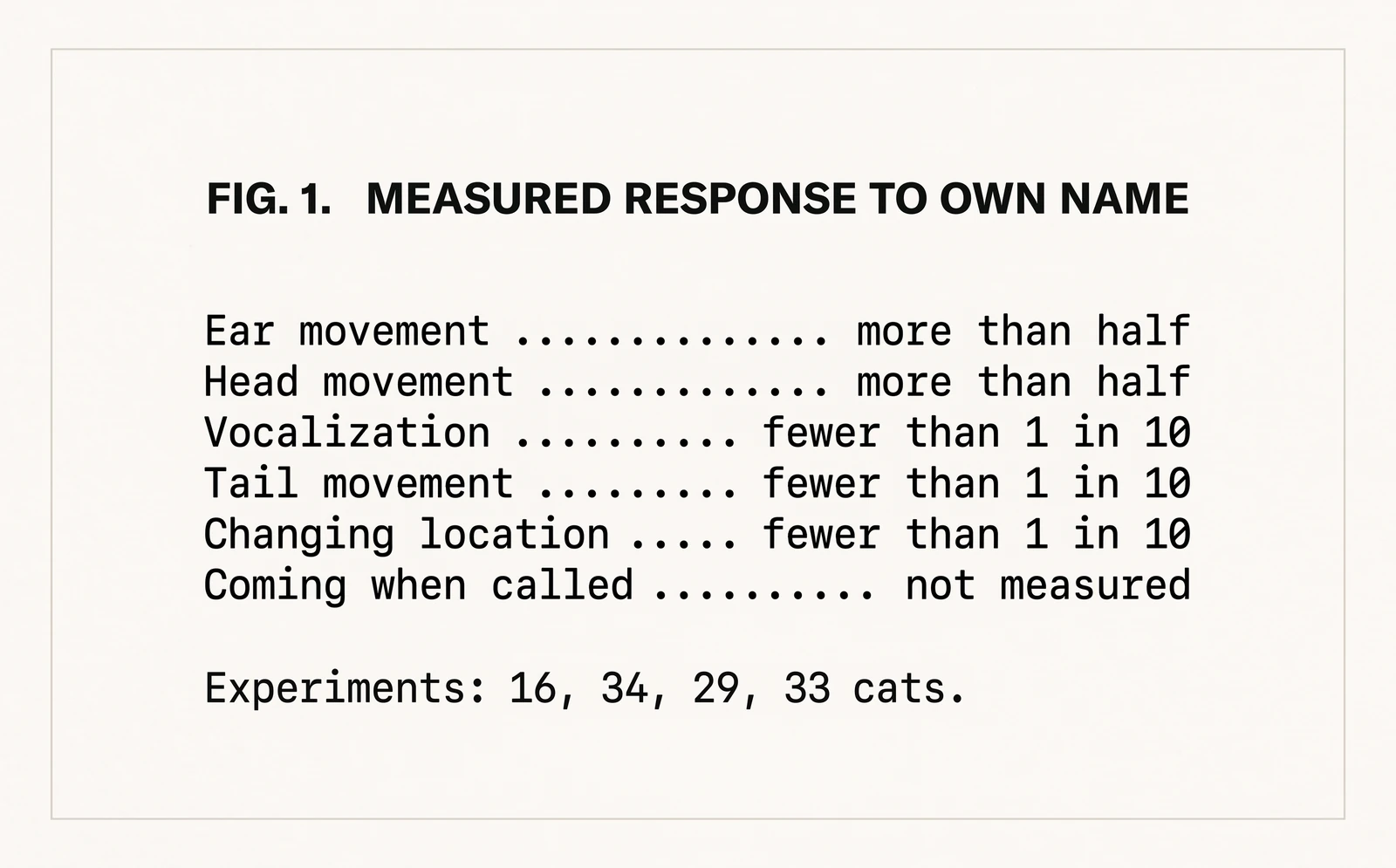
A 2019 study in Scientific Reports by Saito and colleagues ran four experiments with 16, 34, 29 and 33 cats. The conclusion, in the paper's own words, is that "cats can discriminate the content of human utterances based on phonemic differences."
That sounds like a yes.
It is a yes to a narrower question than the headlines asked. The cats told their own name apart from other words that sound like it. Whether the cat understands that the sound refers to the cat is a separate question, and the paper does not claim to have answered it.
How did they measure it?
Habituation and dishabituation, which is a clean design. From the paper:
Cats' responses to the stimuli were expected to decrease during the presentation of words 1 through 4 due to habituation; then, if the cats could discriminate their own names from the other words, responses were expected to increase again when their own names were presented, due to dishabituation.
Play four boring words. The cat stops caring. Play the name. See if the cat cares again.
And when the cat cared again, what did it do?
Here is the sentence:
more than half of the cats responded to voice stimuli by moving their ears and heads; fewer than 10% of the cats demonstrated vocalisation, tail movement, and displacement.
Displacement means changing location.
So fewer than one in ten actually moved.
Correct. The finding is that a majority of cats, on hearing their own name, adjusted an ear. Under ten percent made a sound, moved their tail, or went anywhere.
The paper reports no data on cats coming when called, because that is not what it set out to measure. Nobody has demonstrated that your cat will come. What has been demonstrated is that it heard you.
Is it ignoring me deliberately?
That is not a claim the science supports and I am not going to pretend otherwise. A cat that turns an ear has processed the sound and not acted on it, and there are many reasons an animal does not act, most of them boring.
What you can say, on the evidence, is this: it heard, and then nothing happened, and that is the end of the documented sequence.
Did we domesticate cats, or not?
Not in the way we did dogs. The domestic cat traces to "Near Eastern and Egyptian populations of the African wildcat, Felis lybica," and the arrangement appears to have been mutual. Cats, in the phrasing of the literature, "effectively 'self-domesticated', without losing ancestral traits, such as their hunting behavior."
By about 9,500 years ago people in the Eastern Mediterranean were keeping them closely enough to carry them to Cyprus, where one was buried with a human.
Could my cat survive without me?
Yes. "Domestic cats retain many behavioral traits of their wild progenitor," and "individual cats can survive and reproduce without human assistance."
Cats tested across four experiments: 16, 34, 29, 33. Responded with ear or head movement: more than half. Vocalized, moved tail, or changed location: fewer than 10 percent. Came when called: not measured. Understands the name refers to itself: not claimed. Capable of leaving: yes. No further action was required of the cat.
And we still do this
We took a study that measured ear twitches and turned it into a story about being known.
I have done the voice. I have said the name twice in the kitchen, in the tone, and watched an ear rotate maybe fifteen degrees, and counted that as a relationship. On the evidence available that is exactly what it was: a successful transmission, acknowledged, with no reply expected and none given.
The cat is not withholding anything. It has never once claimed to be in this arrangement for the reasons you are.
Sources
- Saito, A. et al., "Domestic cats (Felis catus) discriminate their names from other words," Scientific Reports (2019), for the four experiment sizes, the quoted conclusion, the quoted habituation and dishabituation design, and the quoted response figures.
- The same paper for what it does not claim: it reports no data on cats approaching when called, and does not state that cats understand their names as referring to themselves.
- Literature on the domestication of the cat, for the quoted origin in Near Eastern and Egyptian populations of the African wildcat Felis lybica, the quoted description of self-domestication, the Cyprus burial at about 9,500 years ago, and the quoted statements that domestic cats retain wild behavioral traits and can survive and reproduce without human assistance.
- Not asserted: that cats ignore their owners deliberately. The study measured attention, not motive, and the post says so.