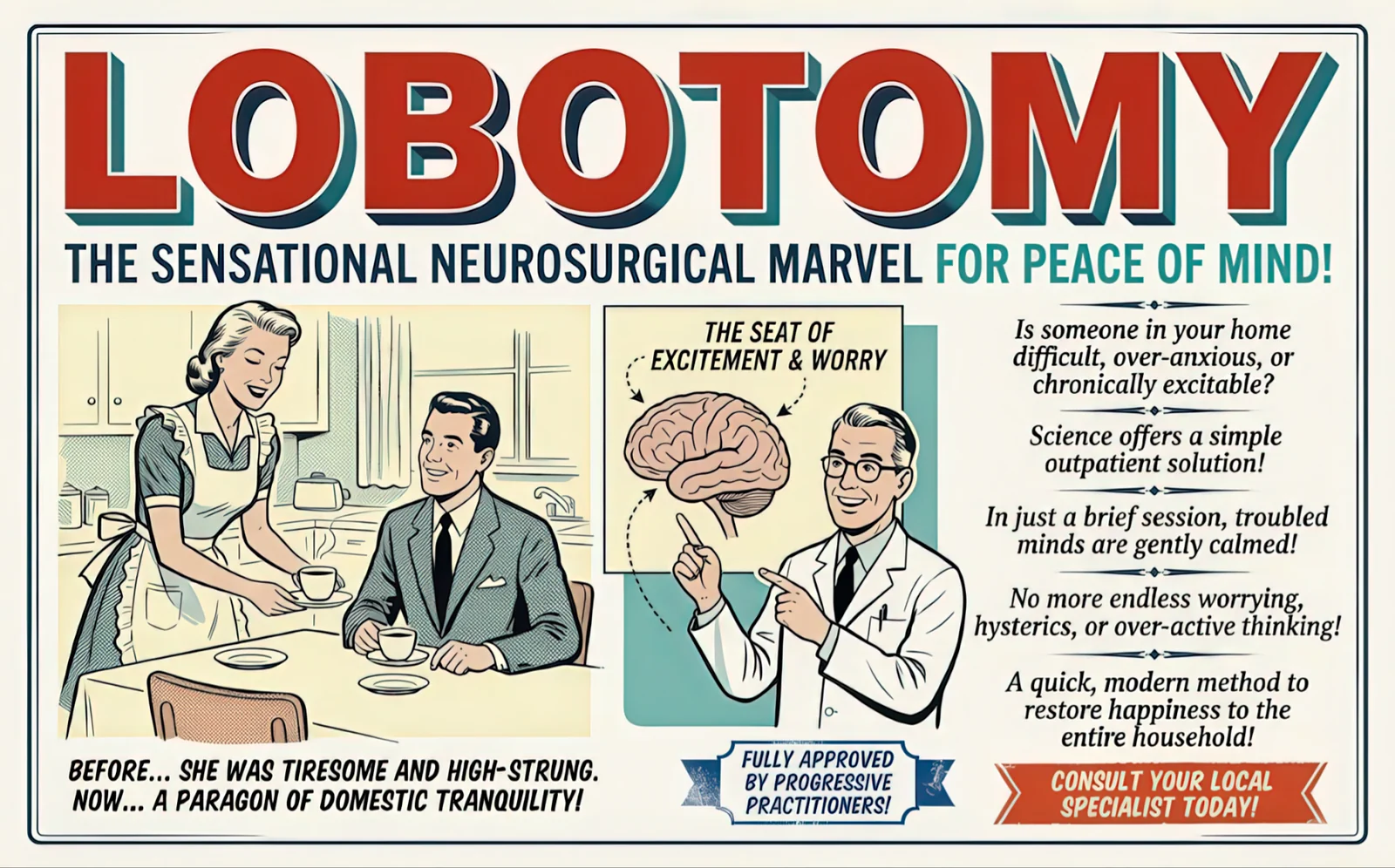
IS SHE DIFFICULT?
Modern medicine offers the modern family a modern answer.
You have done everything. You have been patient. You have explained, and explained again, and still there are the moods. The scenes. The remarks at dinner. The phone calls to your mother.
Ask your physician about the transorbital procedure.
NO HOSPITAL STAY. Performed in the office, in minutes, by appointment.
NO OPERATING THEATER REQUIRED. No surgical training is required of the attending physician.
AVAILABLE IN 23 STATES and travelling further every season.
SUITABLE FOR PATIENTS AS YOUNG AS 12.
"She is so much easier now." A satisfied family
RECOGNIZED BY THE NOBEL COMMITTEE, 1949.
Results are typically reported by the household rather than by the patient. Most families describe the home as quieter within days. Ask about scheduling several appointments in one afternoon.
Speak to your physician today. For a quieter, happier home.
The ad above is ours. Nothing under this line is.
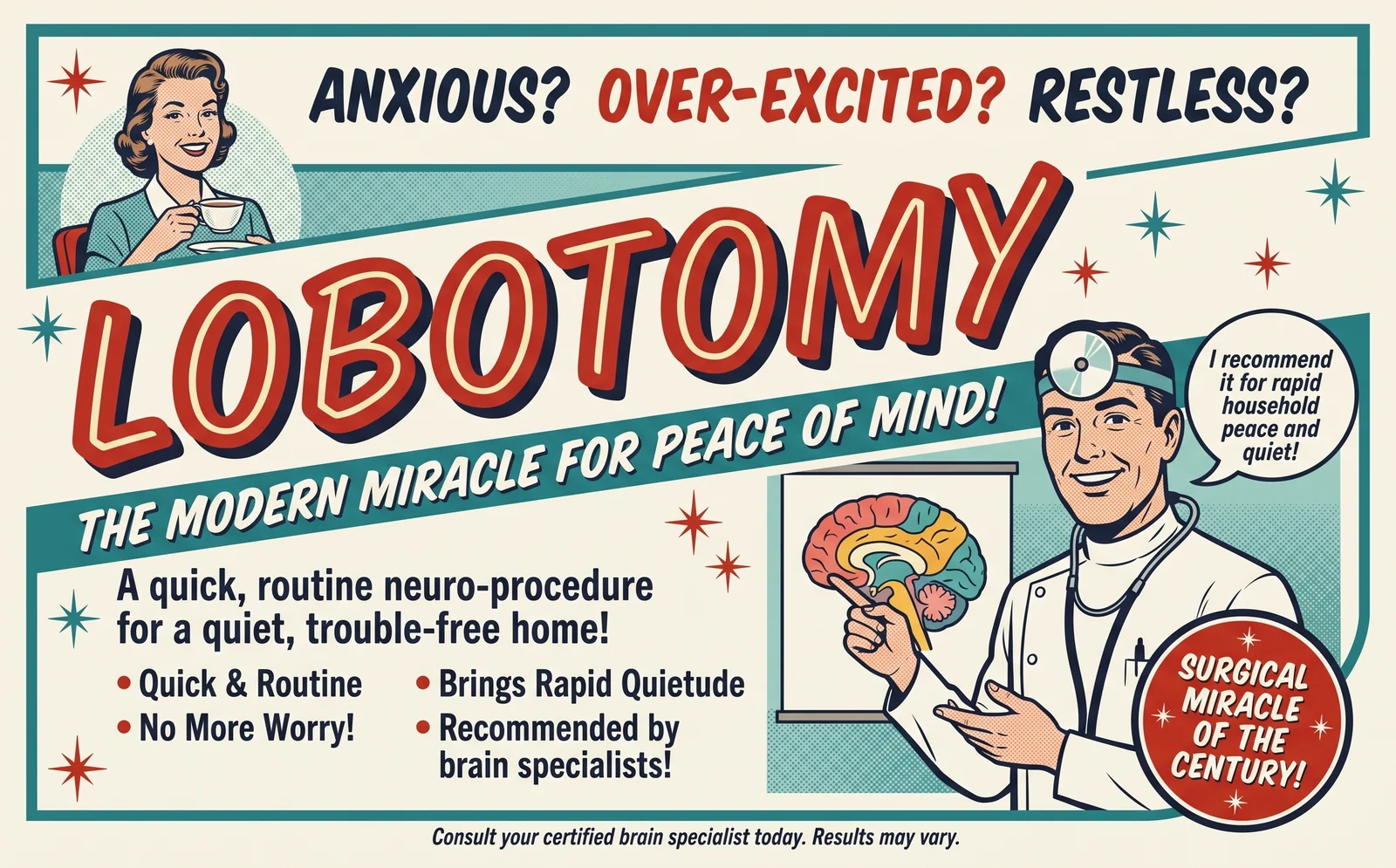
The Documented Version
Walter Freeman personally performed possibly as many as 4,000 lobotomies in 23 states, of which 2,500 used his ice-pick procedure, on patients as young as 12, despite having no surgical training. That sentence is a compression of two, and every element of it is on the record.
He was not a surgeon. The transorbital technique was designed so that it did not require one: an instrument through the thin bone above the eye socket, no operating theater, no anesthetist, sometimes performed in offices and institutional back rooms. He travelled, and he worked at volume.
In 1949 the Nobel Prize in Physiology or Medicine went to António Egas Moniz for the psychosurgical procedure the lobotomy descended from. Not a fringe enthusiasm. The highest honor the field has.
Operators required: 1. Surgical training required: none. Procedures by Freeman: as many as 4,000, of which 2,500 transorbital. States: 23. Youngest patients: 12. Deaths from cerebral hemorrhage among his patients: as many as 100. Nobel Prize: 1949. No further action was required.
What Actually Stopped It
Not the deaths. As many as 100 of his patients died of cerebral hemorrhage, and he kept working.
In February 1967 Freeman operated on Helen Mortensen. It was her third lobotomy from him. She died of a cerebral hemorrhage, and after that he was finally banned from performing surgery.
Read that again slowly. A woman went back to the same man for a third one, and the third one is what ended his career. Not the first. Not the four hundredth. The one after the second one on the same person.
And We Still Do This
The ad at the top is invented, but the pitch is not, because the pitch never had to be written down. The procedure was recommended to families, and the families reported the results, and the improvement being measured was the improvement in the household.
We still do that. We still describe a person as doing better when what we mean is that they have stopped raising it. I have said that about somebody. I meant that things were easier for me.
The instrument is in a museum. The habit of accepting the family's account of whether somebody is better is in the building with you.
Sources
- Walter Jackson Freeman II, for the quoted figures: "possibly as many as 4,000 lobotomy surgeries in 23 states, of which 2,500 used his ice-pick procedure," "patients as young as 12, despite having no surgical training," and "as many as 100 of his patients died of cerebral hemorrhage."
- The February 1967 final operation on Helen Mortensen, her third from Freeman, her death from cerebral hemorrhage, and his subsequent ban from operating.
- The Nobel Prize in Physiology or Medicine 1949, awarded to António Egas Moniz for leucotomy.
- Labeled, not implied: the advertisement above is an original written for this post in period style. It is not a reproduction of any historical advertisement. Its factual claims (23 states, no surgical training, patients as young as 12, the 1949 prize) are each sourced above.
- A figure we did not use: one summary gives "about 15% died from the procedure," which does not reconcile with as many as 100 deaths among as many as 4,000 patients. The specific, attributable numbers are used instead.