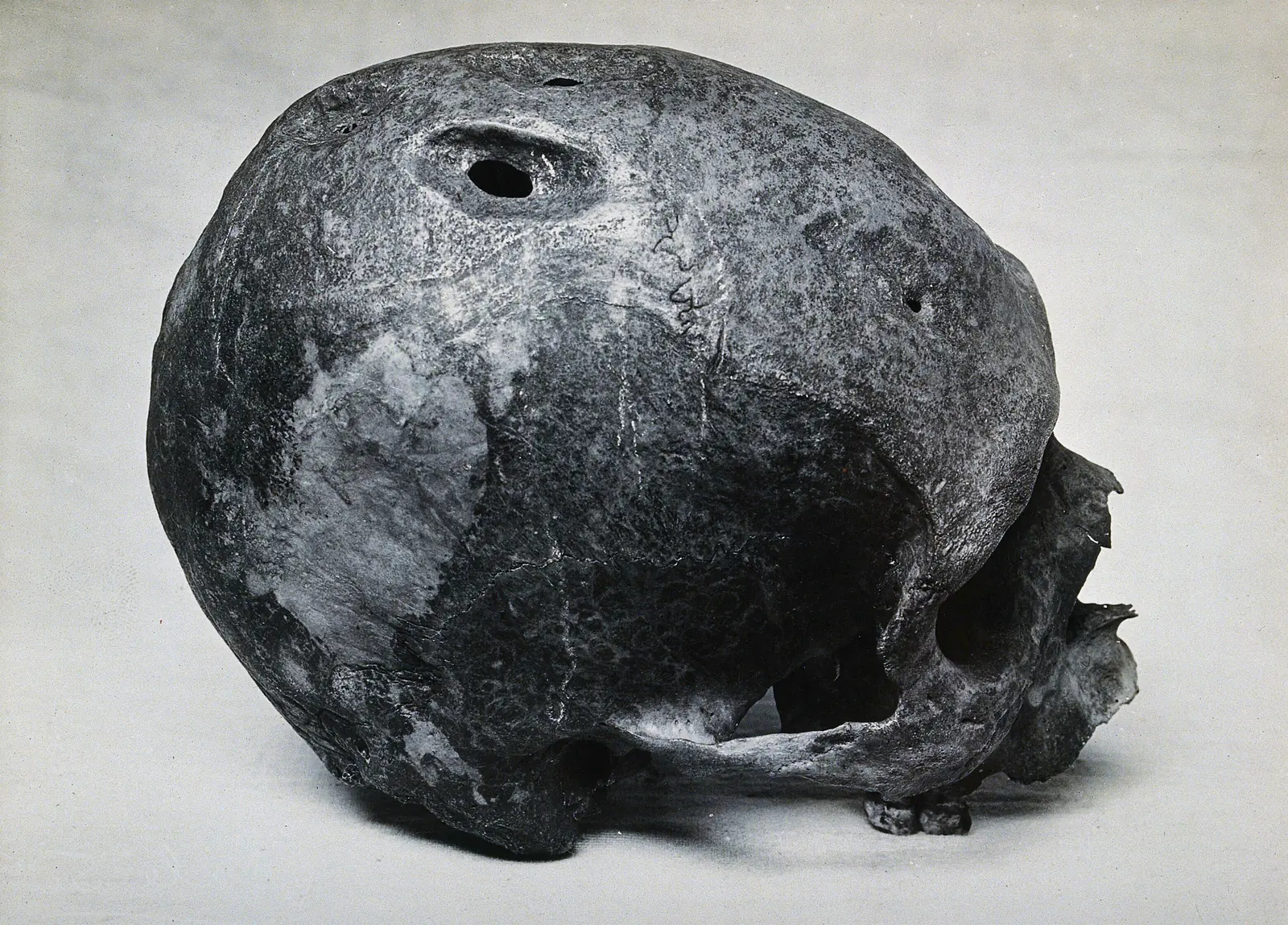
Verified procedure. Hole, frontal, roughly circular. Performed without anesthesia by a practitioner with a bronze tool and, judging by the edges, a great deal of prior experience.
Pros. Fast. No anesthetic to run out of. Demonstrably survivable. The practitioner clearly knew where not to go, which is more than can be said for several later centuries of European medicine.
Cons. The hole.
Why three stars and not one
Because the numbers are the opposite of what you expect, and that is the whole review.
John Verano, a physical anthropologist at Tulane, has studied more than 800 trepanned skulls from Peru across decades. You can read survival directly off a skull: bone that has begun to heal around the opening means the patient lived long enough for it to start.
In the earliest Paracas material there was, in his words, "only about 40 percent survival." By the Inca period the rates, again his words, "push over 70 percent."
They got better. Over thousands of years, with no journals, no anatomy texts and no way to share a result except by standing next to somebody and watching, the practice improved by roughly thirty percentage points. Coverage of Verano's work made the comparison that the late Peruvian rates stood up well against cranial surgery on American Civil War soldiers, which is a sentence worth sitting with for a moment.
One skull in the record belonged to a young man who lived between 3,500 and 3,400 BC. This is the oldest surgery we can prove humans performed, and the reason we can prove it is that people kept surviving it.
Sample: more than 800 trepanned skulls, Peru. Earliest period survival: about 40 percent. Inca period survival: over 70 percent. Anesthesia: none. Written record kept by practitioners: none. Improvement: substantial. No further action was required.
The part that is not funny
We tend to file this under the same heading as bloodletting and the four humors: confident men doing appalling things for no reason. It does not belong there.
Trepanation, for skull fracture and the pressure that follows it, is a real intervention with a real mechanism, and a version of it is still performed today under other names. These were not lunatics with a drill. They were surgeons with a narrow indication and a rising success rate, working in the dark, and they were correct.
The uncomfortable conclusion is not that the past was stupid. It is that being right and being modern are unrelated, and that somebody with a bronze tool and five thousand years of accumulated care can beat a trained physician with a theory.
Would I recommend? Not electively. But if I am going to have a hole made in my head by somebody with no anesthetic, I would rather it were a practitioner whose last forty patients walked home.
Sources
- John Verano, Tulane University, on more than 800 trepanned skulls from Peru, quoted survival figures of "only about 40 percent survival" in the earliest Paracas material and rates that "push over 70 percent" under the Inca, and the trepanned skull of a young man who lived between 3,500 and 3,400 BC.
- Healed bone margins as the evidence for patient survival.
- Attributed, not asserted: the comparison to American Civil War cranial surgery was drawn by press coverage of Verano's study. We could not obtain a quotable mortality figure for Civil War cranial surgery from a source we trust, so no percentage is given here.