The deckThe Evidence15 of 24
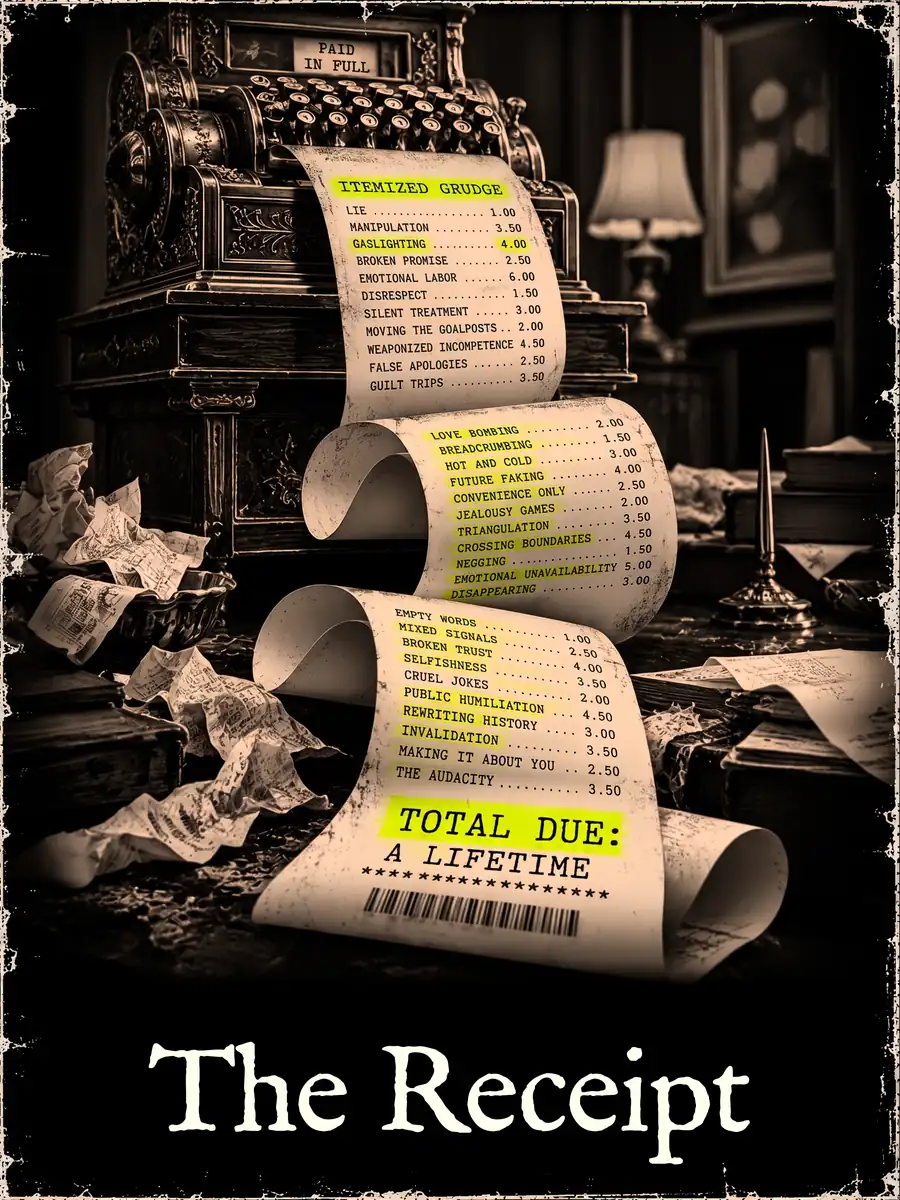
The Receipt
Keeping score, proof, and the cashier you have become.
- Figure
- Proof. The record. The score.
- Pattern
- Keeping count.
- What it protects
- A receipt is never wrong.
- What it costs
- Only you are counting, and it is making you the cashier.
- The move
- Throw out one receipt and see if the total changes.
- ON FILE
- The receipts, totaled, correct.
In each position
HOW IT STARTED
You kept every receipt. You can produce any of them. Nobody has asked.
HOW IT'S GOING
You are counting. You are the only one counting. The total is enormous.
HOW IT ENDS, ALLEGEDLY
You will say you never kept score. You will know the score when you say it.
Three questions
- What are you counting?
- Who else has the total?
- Which receipt could you throw away first?
A sample file
A sample file
The file contains one receipt, very long, itemized by hand and titled in capitals, ending in a total due that has not been invoiced to anyone. This office has checked the arithmetic. It is correct. It is also running at all hours, including on the good days, which it does not record as credits. You have said that you do not keep score, and the office notes that you knew the score at the time you said it. xxxx xxx xxxxxx xx xxxxxxx xxxxxx xxx xxx xxxxx xxx xxxxxxx xxxxxxx xxxx xxxxxxx The office also knows the total on this file to the cent and has not been asked for it either. One receipt has been set aside for disposal as a test, and it is still in the drawer. The total is correct, and nobody else was counting.
EXHIBITS
- A. The receipts, totaled, correct.
- B. Nine drafts, struck through, down to one word.
- C. A stop sign, in use as a tray.
APPROVEDitemized, unrequested
Every file is written for the person who pulled it. This one was written for nobody, so it is the only one you get to read without pulling. One sentence is sealed on every public copy, this one included.
On file in cotton
The shirt

Once a day. Three cards, one finding, a status. How it works.